

Why Most university spinoffs are less likely to fail than industry startups
- Posted On:
- February 26, 2026
- Category:
- Ecad
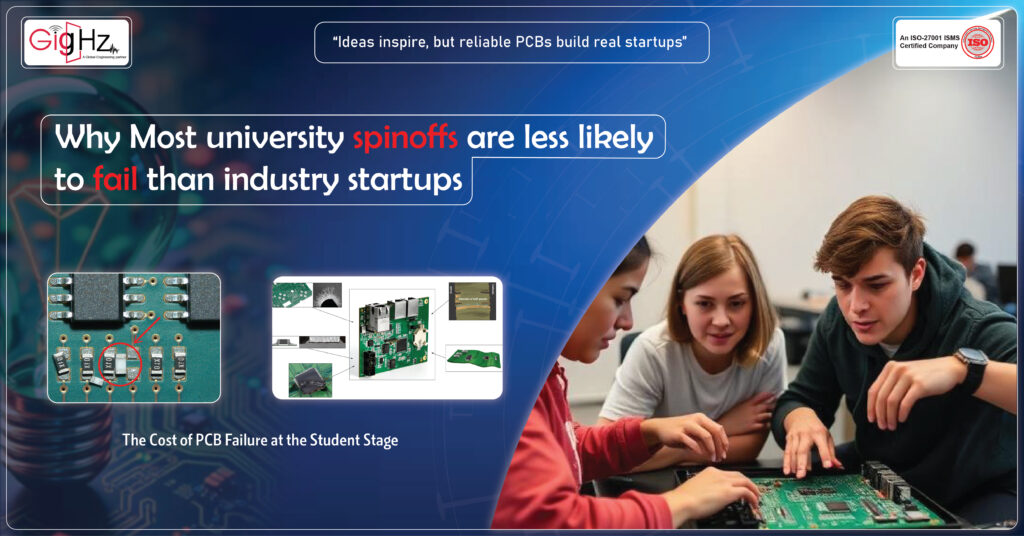
Every year, thousands of brilliant ideas are born inside universities.
Students win hackathons, build final-year projects, and pitch innovative solutions to real-world problems.
Yet, when it comes to University Spinoffs, a harsh truth remains:
Most university startups don’t fail because their idea is weak — they fail because their first PCB fails.
The idea excites. The prototype disappoints. The startup collapses silently.
This blog is a reality check for students who dream of building hardware startups.
If you are serious about converting your idea into a real product, you must understand why the PCB stage becomes the biggest hidden failure point.
1. The Illusion of a “Great Idea” in Student Startups
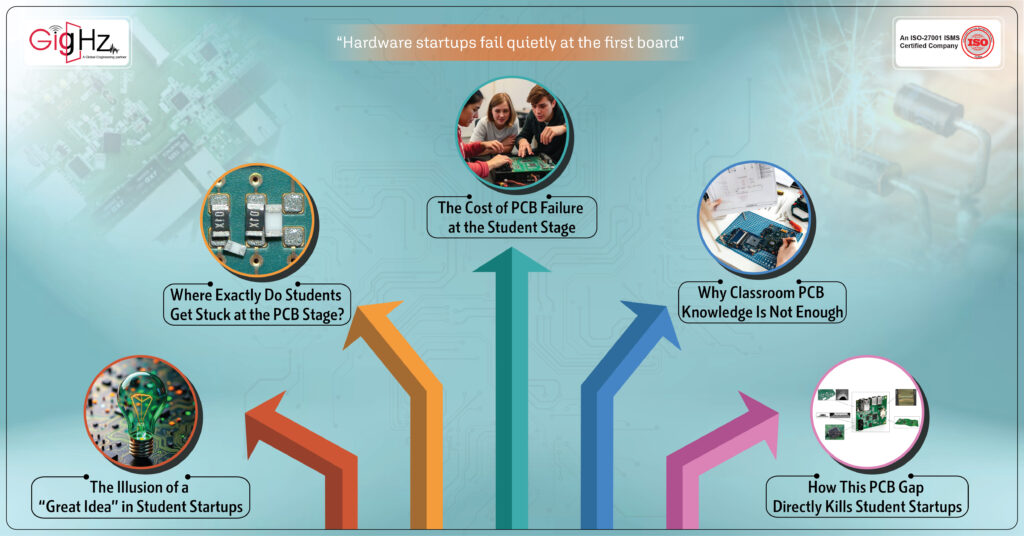
At the student stage, most startup journeys begin with:
- A problem statement
- A clever innovation
- A concept validated by mentors
- A PowerPoint pitch
- A basic block diagram
At this point, everything feels achievable.
But here’s the uncomfortable truth:
An idea has zero commercial value until it becomes a working, reliable, manufacturable product.
And that transformation happens at the PCB stage.
This is where most student startups face their first real-world engineering test — and fail.
2. Where Exactly Do Students Get Stuck at the PCB Stage?
Let’s break down the real technical reasons why student-designed PCBs often fail:
a) Schematic Looks Right, But Works Wrong
Students often assume:
- “If simulation passes, the board will work.”
- “If voltage is correct on paper, power is stable in reality.”
In reality, boards fail due to:
- Poor grounding
- Incorrect decoupling
- No power integrity planning
- Floating reference planes
Result:
Simulation passes
Physical board resets, heats, or dies
b) Wrong Component Selection
Many students choose components based on:
- Online availability
- Low price
- Random reference designs
They ignore:
- Package compatibility
- Thermal ratings
- Lead time & lifecycle status
- Pin-to-pin functional limitations
Result:
- Board is assembled
- But components overheat, latch-up, or fail under load
c) Poor PCB Layout and Routing
Typical student layout issues:
- No controlled impedance
- Poor return paths
- Crosstalk between high-speed signals
- High-current traces routed too thin
These cause:
- Signal distortion
- Noise coupling
- Communication failure
- Random system behavior
The student sees a “mysterious bug” — but the root cause is layout.
d) Ignoring DFM (Design for Manufacturability)
DFM is rarely taught seriously in classrooms.
Common DFM mistakes:
- Below-minimum track widths
- Improper solder mask openings
- Incorrect drill sizes
- Missing fabrication notes
The fabrication vendor then:
- Rejects the board
- Or manufactures a defective board
This results in:
- Cost overruns
- Project delays
- Missed demo dates
- Hackathon disqualification
3. The Cost of PCB Failure at the Student Stage
For students, PCB failure doesn’t just waste money — it kills momentum.
Each re-spin means:
- ₹10,000–₹50,000 extra cost
- 2–4 weeks fabrication delay
- Lost mentor confidence
- Team frustration
- Reduced chances of funding
Most student startups don’t even die dramatically.
They fade out quietly because:
- The PCB keeps failing
- The team runs out of budget
- The excitement dies
The failure is not visible in newspapers — it happens silently in labs and hostels.
4. Why Classroom PCB Knowledge Is Not Enough
Universities teach:
- Basic schematics
- Simple routing rules
- Academic simulations
But real products require more than academic PCB design:
- Power integrity planning
- EMC/EMI awareness
- SI constraints
- Thermal management
- Component derating
- Manufacturing tolerances
This is the key gap:
Students design PCBs like a project. Industry designs PCBs like a product.
And startups need product-grade PCBs.
5. How This PCB Gap Directly Kills Student Startups
Let’s look at how a weak PCB impacts startup success:
Student View | Product Reality |
“It should work.” | Manufacturing failures |
“We’ll debug later.” | Burnt components |
“Second revision will fix it.” | Budget exhausted |
“Let’s try again.” | Team dissolves |
Investors, incubators, and mentors eventually lose trust because:
- Hardware is unreliable
- Timelines keep slipping
- Product quality looks unsafe
At that stage, the idea no longer matters.
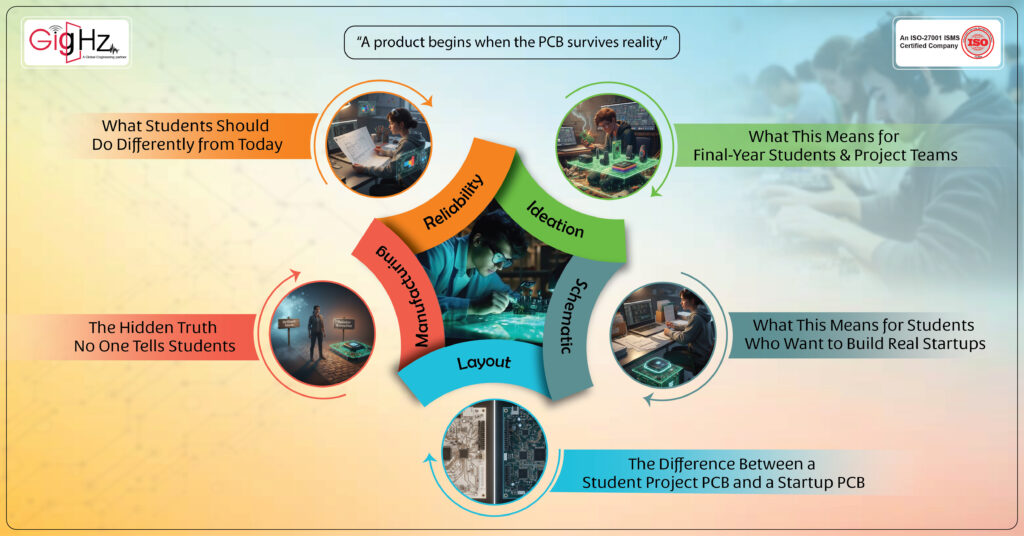
6. What This Means for Final-Year Students & Project Teams
For final-year students, this topic sends a strong warning:
- Your project PCB must be:
- Manufacturable
- Testable
- Reliable
- Not just:
- Demonstrable
- Breadboard-replicated
- Simulation-proven
If your PCB fails:
- Your project may not scale
- Your startup may not survive
- Your career confidence may take a hit
A failing PCB can turn a promising student innovator into a discouraged drop-out founder.
7. What This Means for Students Who Want to Build Real Startups
If you are serious about building a real startup as a student, this blog means only one thing:
You must invest early in learning:
- Industry-level schematic design
- Proper PCB layout techniques
- DFM & DFA rules
- Component engineering
- Manufacturing documentation (Gerber, PnP, test points)
You must stop treating PCB as the “last step.”
It is actually the foundation of your product.
8. The Difference Between a Student Project PCB and a Startup PCB
Student Project PCB | Startup Product PCB |
Works once | Works every time |
Manual debugging | Designed for testing |
Cheap components | Reliable components |
No DFM | Full DFM/DFA |
Demo-focused | Market-focused |
Many students unknowingly design demo PCBs while expecting product results.
This mismatch is where failure begins.
9. The Hidden Truth No One Tells Students
The hidden truth is:
The world rewards reliable execution, not brilliant ideas.
At the student level:
- Everyone has ideas
- Very few can convert them into manufacturable electronics
This is why:
- Only a small fraction of university hardware startups succeed
- Most disappear after the first or second PCB re-spin
10. What Students Should Do Differently from Today
If you are currently a student working on:
- A final-year project
- A hackathon idea
- A prototype-based startup
Start doing this immediately:
- Treat schematic design as a product blueprint, not an academic drawing
- Validate every component for:
- Package
- Availability
- Lifecycle
- Follow DFM rules before layout begins
- Learn basic:
- Power integrity
- Signal routing discipline
- Always design with manufacturing in mind
These five changes alone can increase your startup’s survival probability drastically.
Bottom Line
Your idea may be disruptive.
Your pitch may be powerful.
Your team may be passionate.
But if your PCB is weak, everything collapses.
University startups don’t fail at the idea stage.
They fail at the first board spin.
If you master product-grade PCB design at the University Spinoffs, you don’t just increase your startup’s chance of survival — you future-proof your career in hardware engineering.
Book a Call. Schedule a Free Consultation now. https://calendly.com/gighz/30min
Stuck in a loop of challenges? Always pick smart solution that works
Have you faced costly rework because 2D drawings skipped in MCAD workflows?
Effective way to prevent MCAD documentation errors recalls?
Please answer both poll questions before submitting.
Thank you for your response! 😊
Latest Post
Get Customized Engineering CAD Design Service

Book a Free Consultation Call
Partner with Gighz and bring your most innovative design concepts to life. Our engineering cad services accelerate development so you can focus on your big vision.
