

When Should a Startup Invest in SI PI Simulation?
- Posted On:
- February 27, 2026
- Category:
- Analysis & Simulation
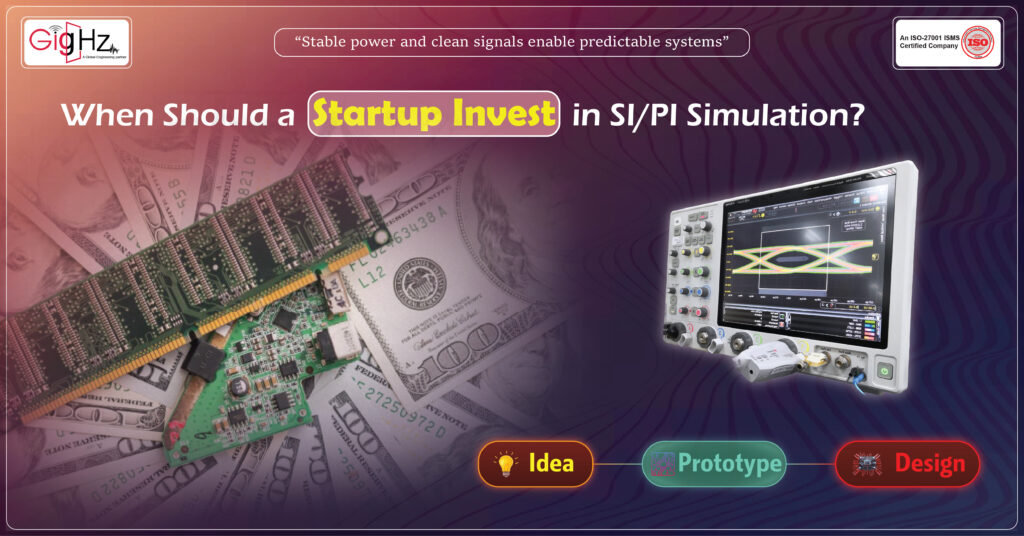
Every hardware startup goes through the same emotional journey. The first prototype arrives.
The LEDs blink. The firmware loads. The team feels a small moment of pride, as if they finally brought an idea to life.
For a while, everything looks good. And then the board starts showing small cracks—random resets, unstable power rails, noisy signals, or a complete failure in EMI tests.
Many founders face these issues without knowing why.
The board works, yet it fails under stress.
It passes simple tests, but not the real ones.
Most of these problems come from one quiet area of hardware design:
Signal Integrity (SI) and Power Integrity (PI).
SI tells you how clean and reliable your signals are.
PI tells you how stable and noise-free your power rails are.
When these two break, everything breaks.
So the real question becomes simple but important for SI PI Simulation:
At what moment should a startup invest in SI PI simulation?
This blog walks through your full hardware journey—prototype to production—and explains the exact stage where simulation becomes not only useful, but necessary.
With simple words, emotional clarity, and deep technical detail, let’s explore this together.
1. Why the timing matters more than the tools
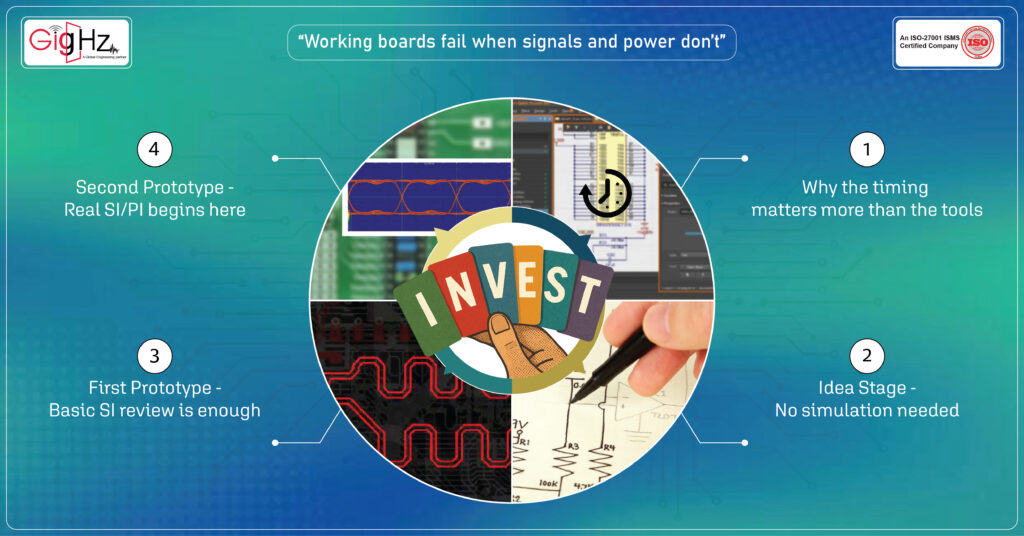
SI PI simulation matters, but its value depends on when it is applied.
When simulation is pushed into the design too early, the layout is still changing and every adjustment triggers another check. Instead of supporting progress, it slows the entire flow.
But when simulation is done only after fabrication, the impact shifts from delay to damage.
Issues that could have been corrected in layout now appear as redesign work, failed test cycles, unstable prototypes, and certification setbacks.
This is why the real decision is not about whether simulation is needed but when it provides the maximum advantage.
The right timing avoids repeated debugging loops, protects early customer trust, and keeps development speed intact.
When simulation is run after layout is mostly final but before release, it delivers what teams actually need.
A design that moves forward without hidden risks and a first prototype that behaves as expected.
2. Idea Stage — No simulation needed
At the idea stage, you are only defining the product: selecting components, choosing interfaces, and setting performance goals.
There is nothing to simulate yet because no layout or routing exists.
The only point to note at this stage is whether the design will include high-speed interfaces.
That awareness will guide later decisions without needing simulation now.
3. First Prototype — Basic SI review is enough
The first prototype is only for proving the concept, not achieving final performance.
The design is still flexible, changes are expected, and another revision will follow. Full SI/PI simulation is not needed at this stage.
What matters is a light integrity check: correct stack-up, controlled impedance on high-speed traces, clean return paths, proper grounding, and avoiding risky routing angles.
These basics prevent obvious layout errors and make the board stable enough for initial bring-up.
4. Second Prototype — Real SI/PI begins here
The second version is where the architecture settles. Components, interfaces, and power rails are defined, and mechanical constraints are now fixed.
At this point, SI/PI simulation becomes essential—especially if the design includes USB 3.x, PCIe, HDMI, DDR, LVDS, Gigabit Ethernet, RF sections, or high-frequency converters.
Version-two failures are costly, so this is the stage to run proper analysis and prevent issues before the design moves closer to production.
5. High-Speed Design Stage — Simulation becomes mandatory
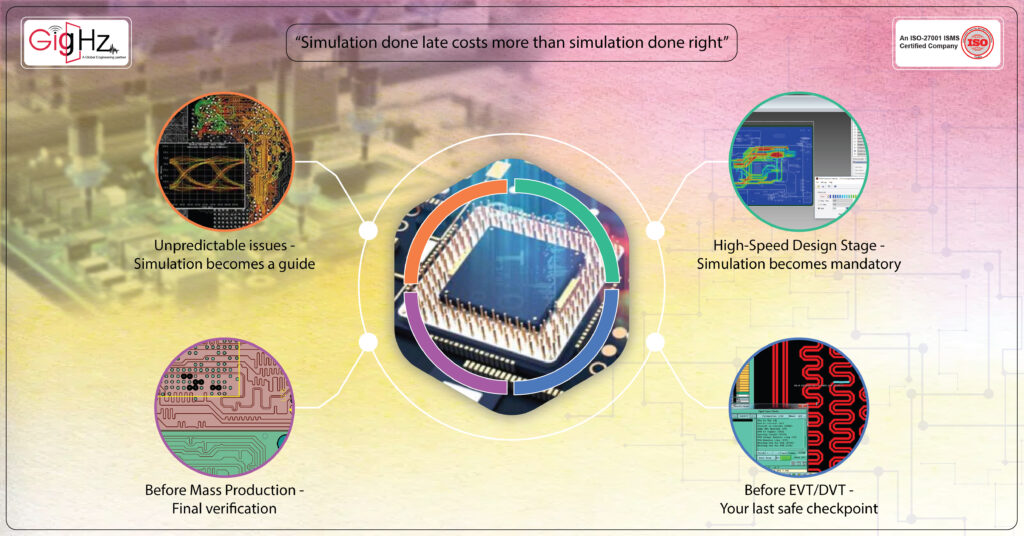
When the design reaches true high-speed operation, simulation is no longer optional.
This is the stage where reflections, timing margins, crosstalk, eye quality, via stubs, PDN stability, and power rail noise must be analyzed before release.
These issues usually do not appear in simple bring-up tests; they surface under stress—EMI evaluation, long-runtime operation, thermal load, and worst-case voltage conditions.
Running simulation at this point prevents failures that only show up later when the product is already near launch.
6. Before EVT/DVT — Your last safe checkpoint
EVT and DVT confirm whether the product is ready for certification and real deployment.
Reaching this stage without SI/PI simulation adds significant risk, because failures now lead to redesigns, schedule slips, and manufacturing delays.
Before entering EVT/DVT, simulation should verify stable power rails, clean signal behavior, proper impedance, reliable high-speed performance, safe decoupling, and correct return paths.
This is the final point where simulation can prevent late-stage issues from becoming launch-blocking problems.
7. Before Mass Production — Final verification
When the design is fully stable, a final SI/PI pass is simply a sanity check.
No deep rework is needed, but you must confirm PDN stability, margin levels on high-speed paths, decoupling placement, trace quality, and tolerance against worst-case manufacturing variation.
At production scale, even small integrity issues multiply into large field problems.
This final verification protects both product reliability and the smooth flow of mass manufacturing.
8. When debugging unpredictable issues — Simulation becomes a guide
Some failures show up only after long operation: random resets, unstable USB communication, Ethernet packet drops, power rail noise, or EMI that fails without a clear trigger.
These issues are difficult to reproduce and often unclear in traditional testing.
At this stage, SI/PI simulation becomes a diagnostic tool. It exposes reflections, coupling paths, weak returns, unstable rails, and hidden integrity limits.
Instead of guessing, the engineer sees the actual signal and power behavior, which turns debugging from uncertainty into a structured, logical process.
So… When should a startup invest in SI/PI simulation?
Here is the simplest answer, with no complexity:
- Idea stage: Not needed
- First prototype: Only light SI review
- Second prototype: Start real SI/PI simulation
- High-speed design: Mandatory
- Before EVT/DVT: Full simulation required
- Before mass production: Final verification
- During debugging: Use simulation to find hidden issues
This sequence protects your speed and reduces risk.
Bottom Line
Hardware startups live in a race against time. There is pressure from customers, investors, and the market.
In this rush, SI/PI simulation often looks like extra work. But in reality, it is one of the most powerful ways to avoid pain.
The truth is simple:
Most hardware failures that slow down a startup are SI/PI failures.
And most of those failures are preventable.
Simulation does not stop problems from happening, but it brings clarity before they become expensive. It saves you from late-stage redesigns.
It keeps your launch timeline safe. And most importantly, it protects your confidence.
In a world where every mistake costs time and trust, choosing the right moment to simulate is not just technical—it is strategic.
If you follow this timing, you build with confidence instead of hope.
And that confidence is what moves a startup forward.
Book a Call. Schedule a Free Consultation now. https://calendly.com/gighz/30min
Stuck in a loop of challenges? Always pick smart solution that works
Have you faced costly rework because 2D drawings skipped in MCAD workflows?
Effective way to prevent MCAD documentation errors recalls?
Please answer both poll questions before submitting.
Thank you for your response! 😊
Latest Post
Get Customized Engineering CAD Design Service
Book a Free Consultation Call
Partner with Gighz and bring your most innovative design concepts to life. Our engineering cad services accelerate development so you can focus on your big vision.
