

Nothing in electronics stays the same for long.
What worked in electronics PCB design five years ago can already feel outdated today as technologies rapidly evolve and product expectations continue to rise.
If you’re still following old design habits, you’re not just behind—you’re risking failures, delays, and higher costs in real-world applications where performance and reliability are critical.
Small inefficiencies in design today can quickly turn into major issues during manufacturing or testing.
The truth is simple:
Modern PCB design is evolving fast—and those who adapt early gain a clear advantage in performance, reliability, and time-to-market.
Engineers and designers are now expected to think beyond basic layouts and consider system-level challenges, manufacturability, and scalability from the start.
Let’s break down the 9 most powerful trends shaping PCB design today and how you can use them to stay ahead of the competition.
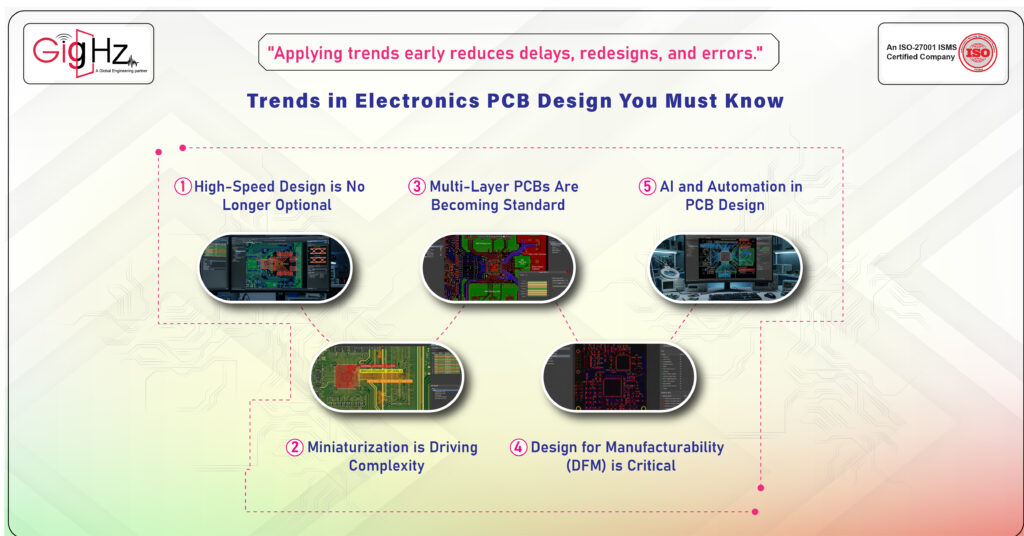
1. High-Speed Design is No Longer Optional
Gone are the days when signal speed didn’t matter.
With faster processors, high-frequency communication, and compact devices, electronics PCB design now demands strong focus on signal integrity.
What’s changing:
- Controlled impedance routing is now standard
- Crosstalk and EMI issues are more common
- Stack-up design matters more than ever
What you should do:
If you’re not simulating high-speed signals, you’re designing blindly.
2. Miniaturization is Driving Complexity
Devices are getting smaller—but expectations are getting bigger.
What’s happening:
- Higher component density
- Finer trace widths
- Tighter spacing
The challenge:
More compact boards = higher chances of:
- Short circuits
- Thermal issues
- Manufacturing defects
The takeaway:
Design precision is now a non-negotiable skill.
3. Multi-Layer PCBs Are Becoming Standard
2-layer boards are no longer enough for modern applications.
Why multi-layer designs are rising:
- Better signal routing
- Reduced EMI
- Improved power distribution
Industry shift:
Even mid-level products now use 4, 6, or 8-layer boards.
Your advantage:
Learning stack-up strategy gives you a massive edge.
4. Design for Manufacturability (DFM) is Critical
A perfect design that can’t be manufactured is useless.
What’s trending:
- Early-stage DFM checks
- Manufacturer collaboration during design
- Standardized design rules
Why it matters:
Ignoring DFM leads to:
- Multiple iterations
- Increased cost
- Delays in production
Smart approach:
Design with manufacturing in mind from Day 1.
5. AI and Automation in PCB Design
PCB design is slowly moving from manual effort to intelligent systems.
Emerging tools can:
- Auto-route complex boards
- Suggest optimal layouts
- Detect design errors early
Reality check:
AI won’t replace designers—but it will replace inefficient ones.
Your move:
Use automation to speed up—not replace—your expertise.
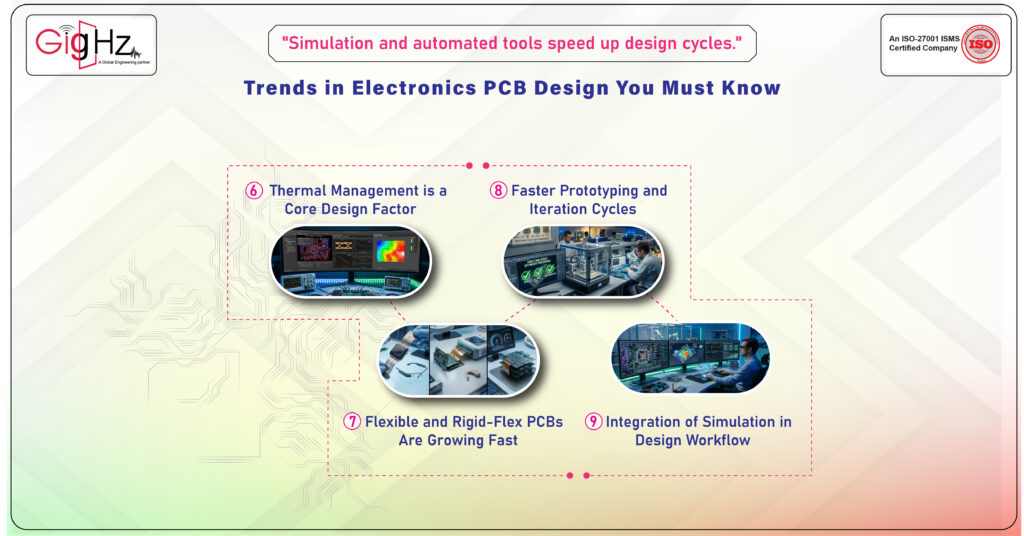
6. Thermal Management is a Core Design Factor
Heat is one of the biggest silent killers in electronics.
What’s changing:
- Higher power density components
- Compact enclosures
- Increased heat generation
Solutions being adopted:
- Thermal vias
- Heat sinks
- Copper pours for heat spreading
Key insight:
If you ignore thermal design, your PCB will fail—even if everything else is perfect.
7. Flexible and Rigid-Flex PCBs Are Growing Fast
Traditional rigid boards are not enough for modern applications.
Where they are used:
- Wearables
- Medical devices
- Automotive electronics
Benefits:
- Space-saving
- Reduced connectors
- Improved reliability
Skill shift:
Designing flex PCBs requires a completely different mindset.
8. Faster Prototyping and Iteration Cycles
Speed is becoming a competitive advantage.
Industry trend:
- Rapid prototyping
- Shorter product development cycles
- Faster validation
Problem:
More iterations = more cost (if not managed properly)
Smart strategy:
Focus on first-time-right design to reduce rework.
9. Integration of Simulation in Design Workflow
Design → Manufacture → Test is no longer linear.
Now it’s:
Design → Simulate → Optimize → Manufacture
What simulation helps with:
- Signal integrity
- Power integrity
- Thermal performance
Why it matters:
Catching issues early saves:
- Time
- Cost
- Reputation
Final Thoughts
PCB design is no longer just about connecting components.
It has evolved into a complex engineering discipline where every decision impacts the final product’s success.
It’s about:
- Performance
- Reliability
- Manufacturability
- Speed
In today’s fast-moving industry, even small design choices can influence signal integrity, thermal behavior, and production efficiency.
Ignoring these factors often leads to costly redesigns, delays, and unexpected failures in real-world applications.
The designers who succeed in electronics PCB design are not the ones who simply know tools or follow basic workflows…
but the ones who understand systems, constraints, and real-world challenges from the very beginning.
They think beyond layout, consider manufacturing early, and validate designs before production.
Because in modern PCB design, success doesn’t come from just building a board—
it comes from building it right the first time
Book a Call. Schedule a Free Consultation now. https://calendly.com/gighz/30min
Stuck in a loop of challenges? Always pick smart solution that works
Have you faced costly rework because 2D drawings skipped in MCAD workflows?
Effective way to prevent MCAD documentation errors recalls?
Please answer both poll questions before submitting.
Thank you for your response! 😊
Latest Post
Get Customized Engineering CAD Design Service

Book a Free Consultation Call
Partner with Gighz and bring your most innovative design concepts to life. Our engineering cad services accelerate development so you can focus on your big vision.
